
Introduction
Unlock your healthiest self with a proven, balanced approach to weekly exercise dosing. Let’s break down exactly how much aerobic and strength training you need, why it matters, and how to structure it effectively—drawing from both CDC’s Physical Activity Guidelines for Americans and the American College of Sports Medicine (ACSM) evidence-based recommendations.
CDC’s Exercise Dosing Recommendations
The CDC advises adults to aim for:
Aerobic activity:
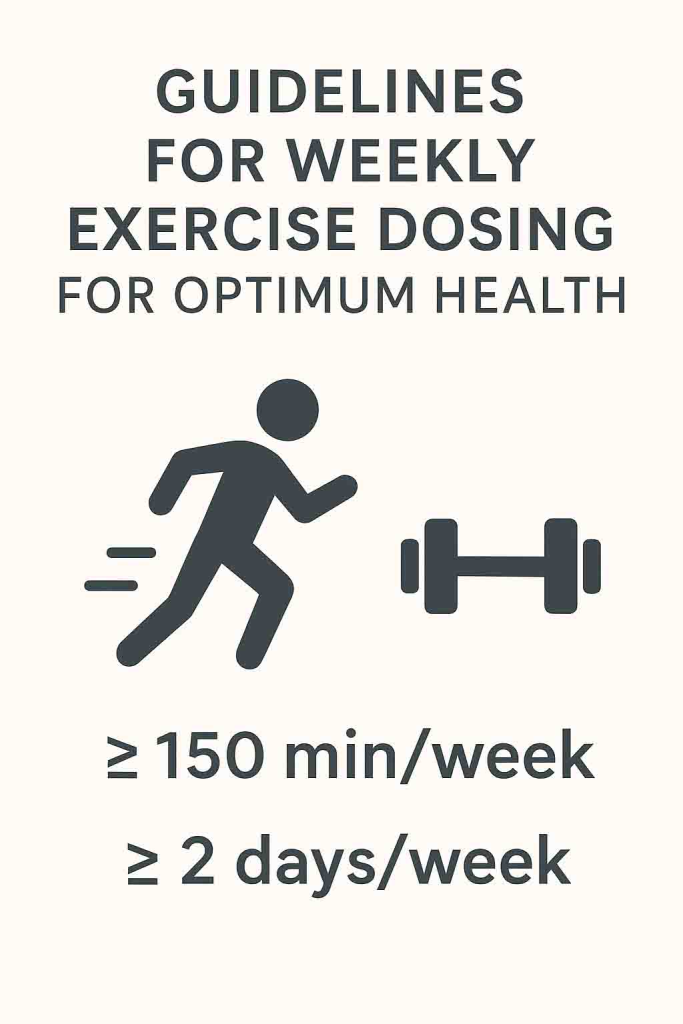
150 minutes per week of moderate-intensity activity (e.g., brisk walking), or
75 minutes per week of vigorous-intensity (e.g., running), or
An equivalent mix of moderate and vigorous intensity CDC+1.
Muscle-strengthening activity: At least 2 days per week, working all major muscle groups CDC+1.
Greater health benefits come from exceeding 150 minutes of aerobic activity—up to 300 minutes of moderate or 150 minutes of vigorous activity per week CDCACSM.
ACSM’s Advanced Exercise Prescription
The American College of Sports Medicine (ACSM) takes this a step further:
Cardiorespiratory (aerobic) training:
Moderate-intensity: ≥ 30 minutes per day, ≥ 5 days/week → ≥ 150 minutes/week.
Vigorous-intensity: ≥ 20 minutes per day, ≥ 3 days/week → ≥ 75 minutes/week.
Or a mix achieving ≥ 500–1,000 MET·minutes per week PubMed.
Resistance & neuromotor training:
2–3 days per week of resistance exercises, targeting all major muscle groups, using appropriately challenging loads.
Include neuromotor training (balance, agility, coordination), and flexibility (≥ 60 seconds per muscle group, ≥ 2 days per week) PubMed.
Alternative minimal baseline (helpful for newcomers or busy folks):
20 minutes of aerobic activity, 3 days/week + one set (8–12 reps) of 8–10 resistance exercises, 2 days/week PubMedFaculdade de Ciências e Tecnologia.
Strength training specifics:
At least two nonconsecutive days weekly.
8–10 exercises, one set each, with 8–12 repetitions (or 10–15 for older or frail individuals), working all major muscle groups RxTGA.
Putting It All Together: Optimum Weekly Plan
| Component | CDC Minimum | ACSM Gold-Standard |
|---|---|---|
| Aerobic | ≥ 150 min mod or 75 min vig per week | Same, but may aim for up to 300 min mod or MET ≥ 500–1,000 |
| Resistance Training | ≥ 2 days/week | 2–3 days/week, 8–10 exercises, 8–12 reps each; add neuromotor & flexibility |
| Flexible Options | — | 20-minute aerobic + single-set full-body resistance (twice/week) for starters |
Why This Dosing Works So Well
Evidence-backed health gains: Reduces risk of heart disease, obesity, type 2 diabetes, certain cancers, and improves mental health and cognition CDCwww.heart.org.
Scalable intensity: Moderate workouts are easier to start; vigorous workouts offer substantial benefits in less time.
Well-rounded fitness: Combines cardio endurance, muscular strength, mobility, balance, and flexibility to support everyday function and aging well.
Beginner-friendly entry point: Even a minimal dose (e.g., 20 min cardio + strength circuit) is beneficial and more achievable PubMedFaculdade de Ciências e Tecnologia.
More delivers better results: Vast research shows health outcomes improve further with greater activity doses—CDC supports up to 300 min of moderate aerobic activity CDCACSM.
Sample Weekly Dosing Schedule
Option A: Balanced Standard Plan
Mon: 30-min brisk walk + strength training
Tue: 30-min brisk walk
Wed: 30-min brisk walk + strength training
Thu: 30-min brisk walk
Fri: 30-min brisk walk
Sat: Optional 30-min walk or active leisure
Sun: Rest or gentle mobility/flexibility session
Option B: Time-Smart Vigorous Mix
Mon: 25-min run + strength training
Wed: 25-min run + strength training
Fri: 25-min run
Add two extra 10–15 min brisk walks/de-stress sessions or mobility work through the week.
Option C: Beginner Starter Template
Tue/Thu: 20-minute walk + circuit resistance training (1 set of 8–10 exercises)
Optional early weekend: 20-minute brisk walk or active hobby
Final Tips for Readers
Customize to your life: It’s not a one-size-fits-all. Pick activities you enjoy and can stick to.
Progress gradually: Start at lower doses, then build to full recommendations to avoid injury and build consistency.
Always rest muscles: Spread strength training across nonconsecutive days.
Mix intensities: A moderate+vigorous combo keeps your routine interesting and adaptive.
Don’t neglect flexibility and neuromotor training—vital for long-term mobility and injury prevention.
Consult your doctor if you have chronic health conditions or aim to shift to vigorous intensity.
Conclusion
For optimum health and longevity, adults should aim for:
Aerobic cardio: 150–300 minutes/week of moderate, or 75–150 minutes/week of vigorous activity (or an equivalent mix).
Strength training: 2–3 sessions/week targeting all major muscle groups with challenging loads.
Bonus assets: Include flexibility and neuromotor training for balance, mobility, and resilience.
Combining the CDC’s practical thresholds with the ACSM’s structured detail gives readers a persuasive, actionable, and authoritative guide—perfect for anyone aiming to level up their health.